
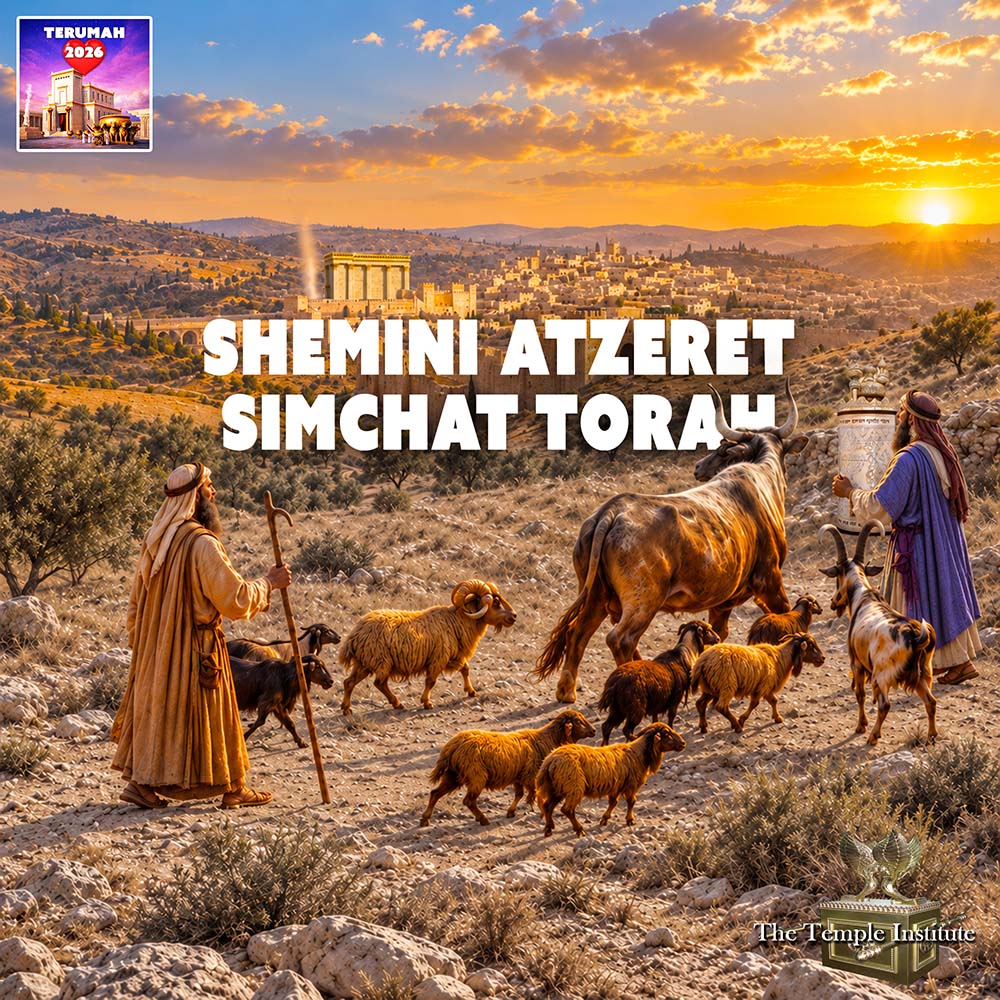
THE DOUBLE HOLIDAY OF SHEMINI ATZERET/SIMCHAT TORAH!
Sukkot is Israel's most universal, outward-looking festival. Throughout the seven days of Sukkot 70 bulls are offered upon the altar on behalf of the seventy primordial nations recognized by Torah. During Sukkot we leave our houses and enter into temporary booths into which we invite family, friends, neighbors, strangers and seven of our most prestigious ancestors: Avraham, Yitzchak, Yaakov, Moshe, Aharon, Yosef and David. The prophet Zechariah speaks of a day when all the nations of the world will ascend to Jerusalem to participate in the Sukkot pilgrimage festival.
And then, just as Sukkot concludes and we depart from out temporary dwellings, the one day holiday of Shemini Atzeret begins! The name Shemini Atzeret literally means the eighth day assembly. But why are we assembling for an eighth day when Sukkot ends on the seventh day? Our sages relate that the Holy Blessed One was saddened by the prospect of all of Israel's pilgrims heading home and leaving Him all alone. So He called upon Israel to stay one day longer. Let the nations return to their shores, G-d told Israel, but you stay, just one more day.
The quiet intimate holiday of Shemini Atzeret, over the years acquired a new facet - the joyful celebration of Simchat Torah - literally - the Joy of the Torah! What better way to honor Israel's special relationship with HaShem than to celebrate the covenant that binds us together - the Holy Torah!
On Simchat Torah we conclude the annual reading of the Five Books of Moses by reading the final parashah of Deuteronomy, in which Moshe blesses each of the twelve tribes before ascending to Mount Nevo for a single glimpse into the land of Israel before passing from this world.
And then we begin again the reading of the Torah by reading the opening chapter of Genesis - the account of the seven days of creation!
And this is followed by dancing with the community's Torah scrolls accompanied by song and prayer.
And then... back to Shemini Atzeret! During the additional Musaf prayer, which recalls the holiday offerings made in the Holy Temple, a special prayer for an upcoming year of abundant rain, just before Israel hunkers down for the winter rainy season.
Throughout the seven days of Sukkot, the number of bulls offered in the Musaf offering was between 7 and 13. The eighth day, however, was the separate holiday of Shemini Atzeret (the Eighth Day Assembly), on which only one bull was offered for the Musaf offering. This was in addition to a goat offered to atone for the sins of the people and a ram and seven lambs as burnt-offerings.
The Talmud (Sukkah 55b) states that the Shemini Atzeret offering is termed a “small feast,” compared with the offerings of Sukkot. It is as if HaShem is telling His beloved Israel, “Let us now celebrate. Prepare for Me a ‘small feast’ just for us so that I can enjoy you.”
Shemini Atzeret in the Holy Temple!

SHANA TOVA & METUKA - BLESSINGS FOR A GOOD & SWEET NEW YEAR FROM THE TEMPLE INSTITUTE!
"And HaShem G-d formed man of dust from the ground, and He breathed into his nostrils the soul of life, and man became a living soul." (Genesis 2:7) Rosh HaShana is the anniversary of the day that HaShem G-d first breathed the divine breath of life into Adam, the father of us all. This same heavenly breath informs each and every one of us. It is the breath of love, the breath of knowledge, of compassion, of friendship, of freedom and of responsibility.
Each year, on the anniversary of Adam's creation, we are commanded to stand before G-d and report on how we are living up to the great gift of life that G-d breathed into us. Am I the person that G-d intended me to be when He first imbued within me the unique breath of my soul? Am I living up to the potential that G-d believes I possess? Am I fulfilling the unique purpose of my existence in G-d's world?
Lest we become overwhelmed by the vastness of these questions we should know that Rosh HaShana isn't simply a time to take stock of our lives up to this moment. Rosh HaShana is a clarion call to step into the new year filled with the determination to truly become that person we are meant to be. To truly live up to our potential and to truly discover and pursue our unique purpose on earth.
The same breath that G-d first breathed into our soul is the breath that sounds the shofar, the central commandment of Rosh HaShana, "a day of sounding the shofar for you." (Numbers 29:1) The wordless voice of the shofar is the inexpressible prayer on all our lips, too deep and too great to be rendered into words. We are commanded not only to sound the shofar but to listen to the shofar. To make our wordless prayer and to hear it, and to follow its message all throughout the days to come. In the wordless, yearning blast of the shofar is a script that is ours to write in the upcoming new year. May we all write ourselves in the Book of Life.
The Temple Institute extends our wishes for a good and sweet new year for all our friends and followers, our faithful supporters, the entire house of Israel and all who befriend the nation of Israel and trust in the unbound goodness of the G-d of Israel. May we all be blessed with health and happiness, prosperity and peace. Shana Tova uMetuka - a good and sweet year for all!
Rosh HaShana in the Holy Temple!
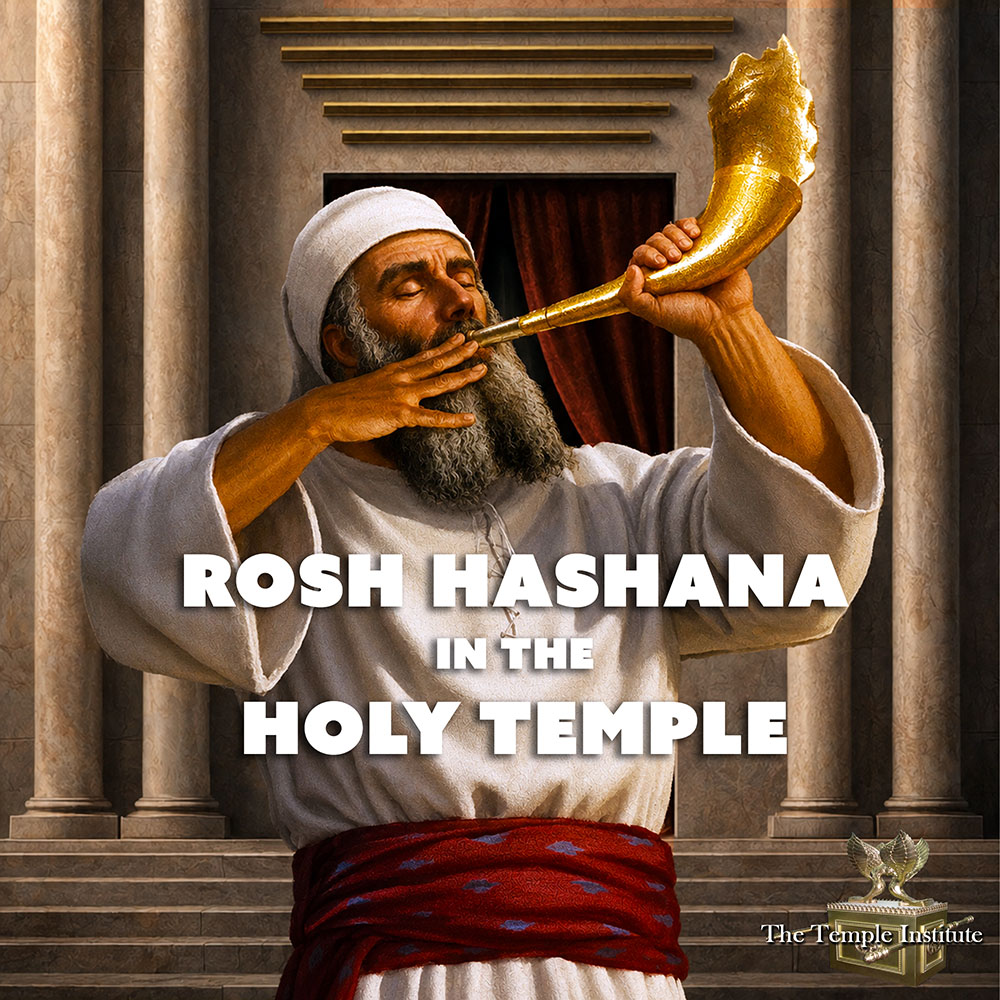
ROSH HASHANA IN THE HOLY TEMPLE!
"And in the seventh month, on the first day of the month, you shall have a holy convocation: you shall do no manner of servile work; it is a day of sounding the shofar unto you." (Numbers 29:1)
To this day sounding the shofar is the principle commandment to be fulfilled on Rosh HaShana. How was it done in Temple times? What offerings were performed? And what special preparations had to be made?
Rosh HaShana begins next Friday evening. Now is the time to learn how Rosh HaShana was celebrated in the Holy Temple!
Rosh HaShana in the Holy Temple!
TISHA B'AV 5786: “AND IN THIS PLACE I WILL GRANT PEACE!”
One G-d, acknowledged by all: that is the one plan in heaven and on earth that can bring lasting peace to mankind. And the one place on earth for all mankind to gather as one and witness the awesome presence of G-d is the Holy Temple in Jerusalem. For 2,000 years we have mourned the tragedies of the past on Tisha b'Av. While we must never forget the destruction of the past, on this Tisha b'Av the time has come to build for the future! “And in this place I will grant peace!” Chaggai 2:9

UPDATE AND CLARIFICATION REGARDING THE RED HEIFER
In light of incorrect information that has been published regarding the red heifer, the Temple Institute would like to announce:
1. For about ten years, the Temple Institute has been engaged in preparations for producing the ashes of the red heifer, both from an educational and practical perspective. The observance of these commandments, the raising of a red heifer according to Torah law and the production of kosher ashes for the purification of the ritually impure, is very complex and includes thousands (!) of details, which require great knowledge and skill in execution. Therefore, the process also includes a number of practical experiments and exercises.
2. About three months ago, a practice was held in the Samarian mountains, in which a simulation of the making of the ashes of the red heifer was conducted.
3. Of course, ashes of the red heifer that are not made on the Mount of Olives while facing the site of the Holy Temple are completely invalid (Mishnah, Para 4:2; Rambam, Para Aduma 4:5). Therefore, we clarify that the simulation was only an exercise, part of a series of exercises that were and, with G-d's help, will continue to be conducted, before we are properly prepared to fulfill the mitzvah according to Torah requirements. The act was not kosher for additional reasons, including: a heifer was chosen for the exercise whose overall color was red, but was, nevertheless, the most invalid and unkosher of the heifers in our possession. (Its tail was damaged and it had a defect). Likewise, the priestly garments worn by the kohen conducting the practice exercise were not consecrated. The purpose of the exercise was to improve our readiness for producing the ashes, and indeed, the exercise improved our understanding of the process, as well as the kohen's skill, and also revealed various weak points that we must deal with, such as the proper way to lead the heifer to its destination.
4. For this reason, the ashes were mostly left by us in place without any care on our part. We did collect samples of the ashes by people who are tamei met, (impure due to contact with a corpse), and are therefore rendered ineligible for performing this mitzvah, only for the purpose of checking whether the equipment we have is suitable for the task, and important lessons were learned in this regard as well. In any case, all of the ashes are completely ineligible.
5. Anyone who claims otherwise, that the heifer was kosher and the ashes produced from it are kosher for the purpose of purification, is mistaken and misleading, either intentionally or unintentionally.
6. There are currently four red heifers at the Shiloh site, some of which are owned by Rabbi Ariel, head of the Temple Institute. Their halachic status has not yet been definitively determined, and we are monitoring them.
7. The real red heifer will be made, G-d willing, when we have a kosher red heifer (according to the opinion of the rabbis of the Temple Institute and the rabbis they consult with), and when we are ready in all other aspects of the matter. This is a long process that requires patience and perseverance.
EXCITING NEWS AT THE TEMPLE INSTITUTE!
In anticipation of Yom Yerushalayim - Jerusalem Day, the Temple Institute recently hosted a festive gathering to celebrate the inauguration of four new films which are now integrated into the guided tour through the Institute's Exhibition, located in Jerusalem's Old Clty’s Jewish Quarter, overlooking the Temple Mount.
The gathering included the sounding of silver trumpets by members of the Temple Institute's Levitical Choir, a screening of samplings from the four new movies, inspiring words from Rabbi Yisrael Ariel, the founder of the Temple Institute, and Chief Rabbi of Israel Kalman Bar.
We look forward to welcoming you at our exhibition hall in Jerusalem!
Yom Yerushalayim Sameach - Happy Jerusalem Day!
PARASHAT TERUMAH & THE TEMPLE INSTITUTE!
This week we are reading the Torah portion of Terumah, (Exodus 25:1 - 27:19), which begins with HaShem's historic disclosure to Moshe that He desires to dwell amongst His people Israel:
"HaShem spoke to Moshe, saying:
'Speak to the children of Israel and let them take for Me a portion; you shall take a portion for Me from every person whose heart is so moved by a spirit of generosity. And this is the portion that you shall accept from them: gold, silver, and copper; blue, purple, and crimson wool, fine linen, goats’ hair; tanned ram skins, tachash skins, and acacia wood; oil for lighting, spices for the anointing oil and for the aromatic incense; shoham stones and stones for setting, for the Ephod and for the Breastplate.'
And they shall make Me a Sanctuary that I may dwell among them." (Exodus 25:1-8)
The continuation of parashat Terumah and much of the rest of the book of Exodus will focus on HaShem's instructions how to build for Him a Sanctuary, the many details of the construction of the Tabernacle, the sacred vessels of service to be used by the kohanim, and the fashioning of the priestly garments, focusing on the eight garments to be worn by the Kohen Gadol (High Priest).
For the Temple Institute these verses are nothing less than the breath of life that informs everything we do, from research and writing, to reproducing the sacred vessels and the priestly garments, to creating an unparalleled archive of paintings depicting life in the Holy Temple, all of which can be experienced in person at our Jerusalem exhibition; from seasonal reenactments of the pilgrimage holiday Temple offerings, to intensive work to produce the longed for ashes of the red heifer, and to the recreation of the Levitical Choir which is already engaged in special holiday performances.
Just as HaShem called upon Israel to open its heart to make possible His dream of dwelling amongst His children, we at the Temple Institute call upon all who long for G-d's nearness and to live in a world worthy of His presence, to give generously to help us to continue our sacred work.
HELP US MAKE G-D’S DREAM COME TRUE!
THE TEMPLE INSTITUTE LEVITICAL CHOIR PERFORMS ACHEINU KOL BEIT YISRAEL
On Passover, (2024/5784) the Temple Institute's Levitical Choir performed an outdoor concert in Jerusalem's Old City Jewish Quarter Central Plaza. Among the songs they performed was Acheinu Kol Beit Yisrael, (Our brothers, the whole house of Israel), an ancient prayer for the safe delivery of Jews in distress, wherever they may be. In light of today's global assault on Jews by jihadists, woke leftists and assorted hate camp followers, the words of Acheinu Kol Yisrael seem more urgent than ever.
Support the work of the Temple Institute!
THE TEMPLE INSTITUTE: BUILDING THE HOLY TEMPLE!
The three weeks of mourning which stretch from the fast of the 17th of Tammuz to the fast of the 9th of Av may be a time for some people to look backward and dream about the Holy Temple that was. Not so for the people that make up the Temple Institute. The Temple Institute is forever looking forward and working tirelessly to educate Israel and the world about the importance of the Holy Temple in our future, while always training and preparing in every way possible for the rebuilding of the Holy Temple and the renewal of the Divine service, soon, and in our days!
Support the work of the Temple Institute!
LEVITICAL CHOIR PERFORMS AT THE SOUTHERN WALL OF THE TEMPLE MOUNT!
Last week, during the intermediate days of Sukkot, the Temple Institute's Levitical Choir joined dozens of other musical Levites in a festive performance of Psalm 27. The Temple Institute's Levitical Choir performers can be recognized by their Levitical uniforms, and, of course, the silver trumpets are those reproduced by the Temple Institute. The concert was a joint production of The Temple Institute, the East Jerusalem Development Company, the Municipality of Jerusalem, and others.
The performance took place on the steps leading up to the ancient Hulda Gates on the Southern Wall of the Temple Mount, the gates through which thousands of pilgrims once ascended from the City of David to the Holy Temple.
"One thing I ask of HaShem, that I seek - that I may dwell in the house of HaShem all the days of my life, to see the pleasantness of HaShem and to visit His Temple all the days of my life."
AVRAHAM & THE SECRET OF THE COVENANT BETWEEN THE PIECES
Slaughter and split the carcasses of three cows, three goats and three rams and walk between them. What was HaShem's message to Avraham in the covenant between the pieces (brit bein habetarim)?
TEMPLE TALK: LECH LECHA - GO FORTH!
AVRAHAM IN SEARCH OF G-D!
PRAYING FOR RAIN IN THE LAND OF ISRAEL!
From the moment G-d called to Avraham to leave all behind and follow Him, everything that we recognize today began to take shape. Lech lecha - go forth - was a jump start for mankind!
Remember: Helping to make HaShem's dream of a Sanctuary in which His Presence can dwell amongst us, is the work of the Temple Institute! Join us in our efforts!
WEEKLY TORAH STUDY: LECH LECHA לך לך
"Are you talking to me?" Where do our thoughts come from? Can our thoughts be recording a conversation between ourselves and G-d?
Lech Lecha (Genesis 12:1 - 17:27)
Parashat Lech Lecha is read on Shabbat:
Cheshvan 13, 5787/October 24, 2026
TISH'A B'AV: BUILD A HOUSE FOR HASHEM!
"Be strong and have courage! Build a House for HaShem!" In this scene from a film soon to become an integral part of the Temple Institute's Jerusalem based Visitors Center experience, the prophet Samuel charges King David with the task of building the Holy Temple!
TISH'A B'AV: THE GLORY OF THIS LAST HOUSE SHALL BE GREATER THAN THE FIRST!
"The Glory of this Last House Shall be Greater than the First!" In this scene from a film soon to become an integral part of the Temple Institute's Jerusalem based Visitors Center experience, Zerubavel from the house of David and Kohen Gadol (High Priest) Yehoshua consult with the prophet Haggai who instructs them to waste no time in rebuilding the Holy Temple!

THE TEMPLE INSTITUTE: BRINGING THE HOLY TEMPLE TO LIFE!
"Speak to the children of Israel, and have them take for Me an offering; from every person whose heart inspires him to generosity, you shall take My offering..." (Ex. 25:2)
Thus begins Terumah, this week's Torah reading, in which HaShem reveals His desire that Israel "make for Me a sanctuary and I will dwell in their midst." (Ex. 25:8)
The Temple Institute is dedicated to making the Holy Temple a reality in our day, and toward this end, the Temple Institute has, for 36 years, been building and planning and researching and teaching and sharing with you our reconstructed sacred vessels and priestly garments, our books and paintings, our red heifer candidates, our teachings and insights and our love for HaShem and the Holy Temple!
It is only through the generosity of your hearts that we are able to continue our important work. Only together can we build for HaShem a sanctuary and "a house of prayer for all nations!"

THE RED HEIFER!
The ashes of the red heifer, essential for the renewal of the Divine service in the Holy Temple, is one of the Torah's most fascinating and mysterious commandments. In our brand new in-depth entry, learn what constitutes "a perfectly red unblemished cow," how the ashes are made and how they are applied, the history and the mystery of the red heifer, and current efforts to raise a red heifer. Beautifully illustrated and extensively footnoted!
On Thursday, September 15, 2022, 5 PM, 5 perfect, unblemished red heifers arrived in Israel from the USA. A modest ceremony was held at the unloading bay of the cargo terminal at Ben Gurion airport, where the new arrivals were greeted and speeches were made by the incredible people who have put their hearts and souls and means into making this historic/prophetic day become a reality.
We invite you to join us in our worldwide effort to produce the longed-for ashes of the red heifer!
Subscribe
 Please wait...